Continuous Atmosphere Brazing Furnace: Nitrogen Purity and Dew Point Control Logic
The goal of the protective atmosphere is to stabilize a low-oxygen, low-moisture environment, and to work in coordination with furnace sealing and exhaust.
Jinglian Zhongrui Technology Team
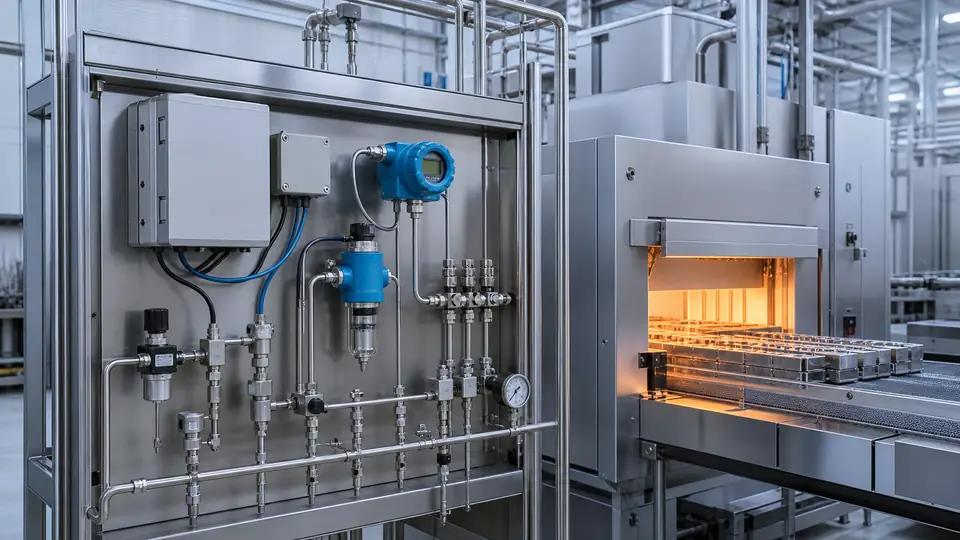
Key Points Nitrogen indicators are only meaningful when combined with measurement point location, furnace pressure, and feed-in/feed-out disturbances. Abnormal dew point or oxygen content may originate from gas supply, sealing, product carryover, or exhaust organization.
Implementation Focus 1. Define monitoring points at the gas supply inlet, key furnace zones, and exhaust end. 2. Analyze dew point, oxygen content, furnace pressure, flow, and product rhythm in a linked manner. 3. Establish a leakage checklist for furnace doors, curtains, flanges, and circulation systems. 4. When abnormalities occur, first distinguish between instrument drift, gas supply issues, and actual air ingress.
Verification and Closed Loop Trends should cover the entire process of stable production, model changes, shutdown/restart, and abnormal recovery.
Project Recommendations During scheme review, input conditions, target values, verification methods, and responsible persons should be recorded in the same traceable document; changes should be synchronized to assess impacts on design, manufacturing, and delivery.Doing this can transform experience into stable and replicable engineering capability. Further reading: Solvay NOCOLOK Technical Center: https://www.solvay.com/en/brands/nocolok/technical-center Solvay NOCOLOK Technical Data: https://www.solvay.com/en/brands/nocolok/publications