Radiator and Intercooler Stacking: Reviewing a Shared Airflow Path
Evaluate air preheating, combined restriction and simultaneous loads when a radiator, intercooler and oil cooler share one cooling package.
China Thermic Editorial Team
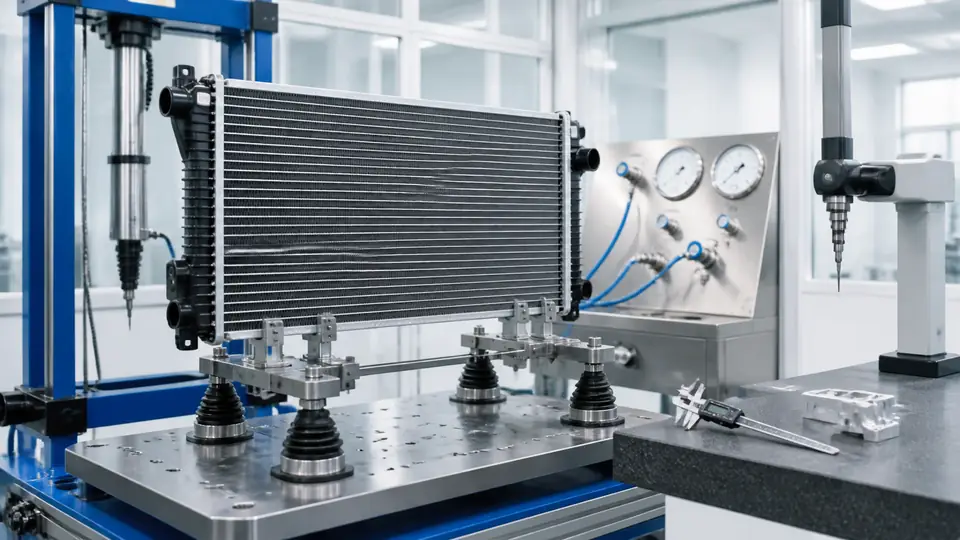
A stacked cooling package should be evaluated as an interacting system. The first heat exchanger warms the air entering the next one, while all components contribute to the resistance seen by the fan. Independently acceptable components may therefore miss the installed cooling target.
BUILD A LOAD MAP
List the radiator, charge-air cooler, oil cooler and any condenser in the airflow path. For each circuit, record the required heat rejection, fluid temperatures, fluid flow and allowable pressure loss. Identify which loads occur together. A worst-case condition should represent a credible operating scenario rather than an arbitrary sum of unrelated maximum values.
CHECK AIR TEMPERATURE AT EACH STAGE
Downstream components receive preheated air. Use measured or calculated inlet conditions for each stage instead of assigning the same ambient temperature to every exchanger. Where an upstream component has a strongly nonuniform outlet temperature, include the effect of that distribution in the review.
COMPARE ARRANGEMENTS
Consider the order of components, available frontal area, sealing between stages and access for maintenance. A side-by-side layout may reduce preheating interactions but requires different space and airflow distribution. A stacked layout can save frontal space while increasing the importance of fan matching. There is no layout that is best for every machine.
VALIDATE SIMULTANEOUS OPERATION
Instrument each fluid circuit and measure fan speed and inlet-air conditions. Run the relevant simultaneous loads, then compare results with the agreed limits. Record whether changes improve one circuit at the expense of another. Check that maintenance access is practical after hoses, guards and panels are installed.
FREQUENT QUESTION: SHOULD THE RADIATOR ALWAYS GO LAST?
No universal sequence applies. The order depends on temperature requirements, heat loads, packaging and allowable air restriction. Decide using the complete system data.
BUYER CHECKLIST
Request a package-level performance review, an installation drawing showing airflow direction, the agreed simultaneous-load cases and a test report that identifies conditions for every circuit.