Radiator Fan and Shroud Design: Preventing Hot-Air Recirculation
Improve installed cooling performance by checking fan coverage, shroud sealing and hot-air recirculation before increasing radiator size.
China Thermic Editorial Team
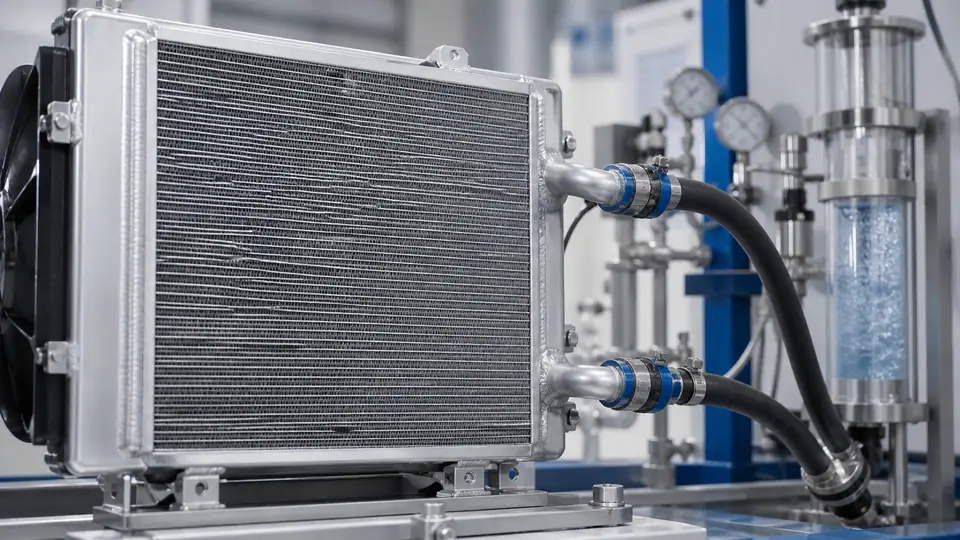
A radiator that performs well on a test bench can still overheat inside a machine. Before specifying a larger core, establish whether the fan actually draws outside air through the full radiator face or repeatedly pulls heated discharge air back into the inlet.
WHY THE INSTALLATION CHANGES THE RESULT
The fan, grille, shroud, core and outlet path form one airflow system. A restriction downstream of the radiator can limit flow just as an obstructed inlet can. Gaps around the core provide bypass routes, while an exposed path between the hot and cold sides can encourage recirculation. A free-air fan rating does not describe the airflow delivered against the installed system resistance.
WHAT TO CHECK ON THE MACHINE
Start by recording coolant inlet and outlet temperatures, ambient temperature away from the machine, radiator inlet-air temperature and fan speed at a repeatable operating condition. Map several positions across the core rather than relying on one air-temperature sensor. An inlet hotter than the surrounding ambient warrants investigation of recirculation and upstream heat sources.
Inspect seals, shroud attachment, fan clearances and the outlet opening against the approved design. Look for uneven contamination patterns that may indicate uneven airflow. Any temporary airflow modification should retain guarding and the clearances required by the equipment manufacturer.
HOW TO VALIDATE A CHANGE
Compare the original and revised installation under matched load, ambient conditions and coolant flow. Log temperatures until the chosen steady-state criterion is reached. Include fan power and noise where these are project constraints. A lower coolant temperature achieved only by substantially increasing fan power is a trade-off that should be documented.
FREQUENT QUESTION: WILL A MORE POWERFUL FAN SOLVE OVERHEATING?
Not necessarily. If air bypasses the core or recirculates, additional fan capacity may provide limited improvement. Diagnose the flow path before selecting a replacement fan.
PROJECT INPUTS
For a cooling-system review, prepare installation drawings, fan performance data, operating logs and photographs of both sides of the radiator.