Radiator Thermal Testing: Use Heat Balance to Check the Data
Review coolant flow, temperature measurements and heat balance before accepting a radiator thermal-performance test result.
China Thermic Editorial Team
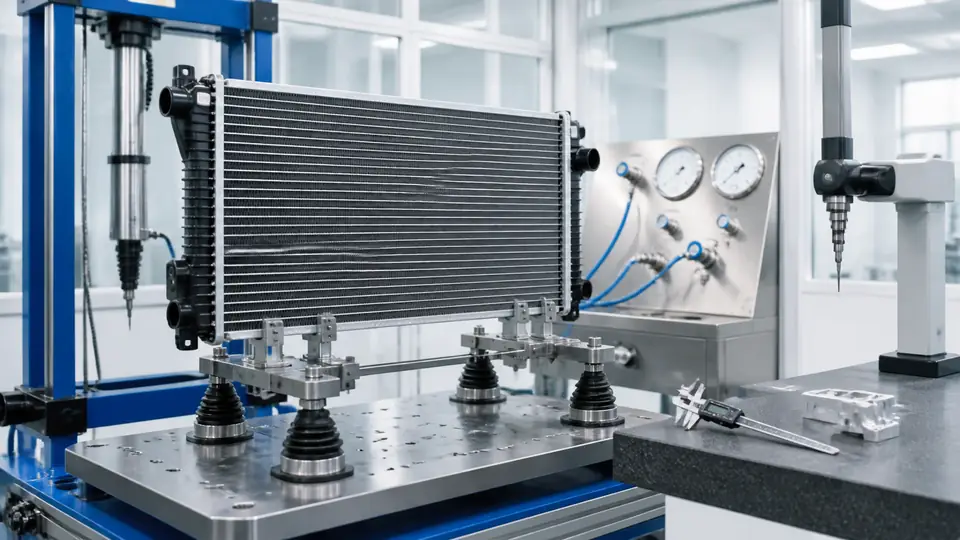
A thermal-performance result should be supported by a measurement review, not just a reported heat-rejection number. Start by checking fluid properties, flow measurements, temperature locations and the stability of the operating point.
CALCULATE WITH CLEAR ASSUMPTIONS
For a single-phase coolant stream, a common heat-rate calculation is Q = mass flow x specific heat x temperature drop. Use compatible units and properties for the actual coolant mixture and temperature range. If the instrument measures volumetric flow, conversion to mass flow requires the appropriate density.
ILLUSTRATIVE EXAMPLE
At a mass flow of 2 kg/s, an assumed specific heat of 4 kJ/(kg K), and a temperature drop of 10 K, the calculated heat rate is 80 kW. This example explains the calculation only. The assumed property value is not a specification for a particular coolant or a product performance claim.
REVIEW THE MEASUREMENTS
Confirm sensor locations and whether the fluid is adequately mixed at those locations. Check calibration status, response time and logging intervals. When the measured temperature difference is small, temperature-measurement uncertainty can have a large effect on the calculated heat rate. Record the uncertainty basis with the result.
COMPARE INDEPENDENT EVIDENCE
Where an air-side heat balance is available, compare it with the coolant-side result. Investigate discrepancies using heat losses, air distribution, measurement uncertainty and whether steady conditions were achieved. Agree on an acceptable balance criterion before the test instead of selecting one after seeing the data.
FREQUENT QUESTION: DOES ONE SUCCESSFUL TEST QUALIFY EVERY VARIANT?
No. The tested configuration, coolant, flow rates and boundary conditions define what the result demonstrates. Variant coverage needs an explicit engineering rationale.
TECHNICAL REFERENCE
NIST explains that measurement traceability requires a documented calibration chain and associated uncertainty. That supports the measurement review; it does not certify a particular radiator test. https://www.nist.gov/metrology/metrological-traceability