Remote Radiator Piping: Build a Coolant Pressure-Loss Budget
Review radiator, piping and component resistance together before approving a remote cooling circuit or extending existing coolant pipework.
China Thermic Editorial Team
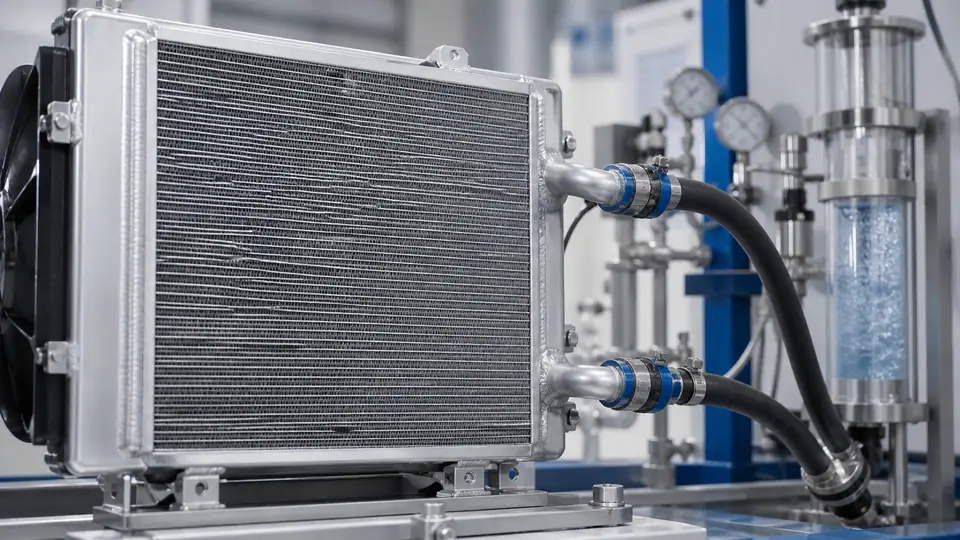
A remote radiator needs a coolant-circuit review as well as a thermal rating. List every component in the proposed flow path and confirm that the installed circuit can deliver the required coolant flow within the equipment manufacturer's limits. Moving a radiator farther away changes the installation being approved.
DRAW THE COMPLETE CIRCUIT
Start with a single diagram showing the engine or process load, radiator, connecting pipes, flexible sections, valves and any intermediate heat exchanger. Mark flow direction, branch connections and elevation changes. Distinguish the intended operating arrangement from the valve positions used for filling or maintenance.
Cummins' generator application guidance identifies engine-pump static and friction-head limits as factors in choosing a remote cooling arrangement. This supports checking the installation against the specific equipment data. It does not provide one universal pipe length or elevation allowance for all generators.
CREATE A RESISTANCE REGISTER
For each component, record the pressure-loss data, coolant condition and flow to which the data applies. Request the radiator's coolant-side information rather than assuming a connection diameter defines its resistance. Identify pipe sections and fittings consistently with the installation drawing so later routing changes can be evaluated.
Keep the resistance calculation and elevation or pressurization review clearly identified in the engineering record. They answer different questions and should not be combined into an unexplained total. The equipment designer should confirm the applicable pressure, filling and venting requirements for the actual circuit arrangement.
COMPARE A CHANGE BEFORE INSTALLATION
When an installer proposes extra elbows, a different valve or a smaller flexible connector, record the change and update the affected calculation. Define who may approve substitutions. A purchase order that lists only radiator capacity and pipe connection size leaves this responsibility unclear.
At commissioning, use the agreed measurement arrangement to verify flow and relevant pressures under representative operating conditions. Record the final pipe route and valve configuration with the results. An approved drawing is most useful when it describes the installed system.
FREQUENT QUESTION: CAN A LARGER PUMP COMPENSATE FOR ANY PIPE ROUTE?
No. Pump changes must remain compatible with the complete circuit and equipment requirements. Review the cause of insufficient flow and obtain an approved system solution.
DECISION CHECKLIST
Confirm the circuit drawing, equipment limits, component loss data, coolant basis, substitution authority and commissioning measurements before releasing the installation.
SOURCE
Cummins, Liquid Cooled Generator Set Application Manual, remote cooling systems. https://incal.cummins.com/www/literature/applicationmanuals/t030.pdf